HOW MUCH IS A METEORITE WORTH?
As is the case with most collectibles, the commercial value of a meteorite is determined by a number of factors including rarity of type, provenance, condition of preservation, and beauty or aesthetic appeal. It is important to note that new and noteworthy meteorite finds should always be made available to the scientific community for study. Once a meteorite has been analyzed and classified by academia, surplus specimens find their way onto the commercial market. The process of acceptance into the official scientific literature actually adds commercial value to a meteorite.
Meteorite prices vary from one source to another but the numbers quoted here are typical of retail values in today’s marketplace. Unclassified stone chondrites picked up by nomads wandering in the Sahara Deserts are readily available for about $0.50/gram. Attractive stones from the Gao-Guenie witnessed fall (Burkina Faso, Africa, March 5, 1960) can be purchased for about $1.50/gram and a top quality one-kilogram specimen of the Campo del Cielo iron meteorite from Chaco Province, Argentina can be yours for about $400.
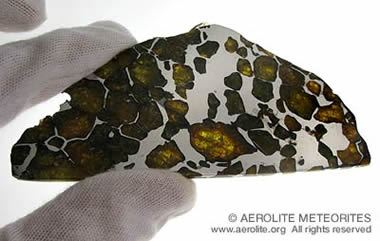 |
| A 67.9-gram half slice of the Imilac pallasite from Chile's Atacama Desert. This meteorite has been sectioned and polished to reveal beautiful translucent olivine crystals. Pallasites are believed to have formed at the core/mantle boundary of large asteroids and are among the most sought after of meteorite collectibles. Imilac is a particularly stable pallasite and examples such as this one, with clear and colorful crystals, are highly prized by collectors. Photograph by Leigh Anne DelRay © by Aerolite Meteorites. |
The Russian iron Sikhote-Alin (fell February 12, 1947) is the largest single meteorite event in modern recorded history and individuals — meteorite specimens which landed as one intact piece, rather than exploding on or near the ground — are coveted by collectors because of their marvelous sculptural qualities and surface features. A premium Sikhote-Alin specimen will carry a price tag of $2 to $3/gram.
Pallasites are stony-iron meteorites packed with olivine (the gemstone peridot) and are particularly desirable when cut and polished because of the alluring color and translucency of the crystals they contain. Prepared slices of stable pallasites such as Imilac (Chile), Glorieta Mountain (New Mexico, USA) and Esquel (Argentina) are prized for their colorful gemstones and long-term stability, and will fetch between $20 and $40/gram. Meteorites are heavy, so a quality slice the size of a small dinner plate is worth thousands of dollars.
At the high end of the pricing scale are unusual types such as the diogenite Tatahouine (fell June 27, 1931, Foum Tatahouine, Tunisia). A prime specimen will easily fetch $50/gram while rare examples of lunar and Martian meteorites may sell for $1,000/gram or more — almost forty times the current price of gold!
 |
| A magnificent 1,315-gram complete iron meteorite from the Sikhote-Alin witnessed fall of 1947. This outstanding aesthetic specimen is partially oriented, covered with fine regmaglypts (thumbprints) and displays an extremely rare large natural hole. Fewer than one in a thousand iron meteorites have naturally-occurring holes, and a meteorite of this quality would make a fine centerpiece in a major collection. Photograph by Geoffrey Notkin © by Aerolite Meteorites.. |
Meteorite Dealers:
Where to Buy a Meteorite
A Google search for the phrase “meteorites for sale,” at the time of writing, produced 91,300 returns, so there is plenty of choice out there in cyberspace.
My most important piece of advice to all collectors, particularly novices, is this: know your source! Meteorites are expensive and maintaining a good reputation as an honest dealer is vital in our business. Many high value specimens are sold in extremely small part slices, particularly lunar and Martian meteorites. A sub-gram fragment of a shergottite from the planet Mars may look uncomfortably similar to a blob of cement, so it is critical to know that you are purchasing from a reputable source. There are plenty of fake and misrepresented meteorites out there, particularly on eBay, so always purchase from an established and experienced dealer who will stand behind the authenticity of his or her merchandise.
It can be amusing and slightly disconcerting to browse the meteorite lots on eBay. It seems that every other offering is described as “awesome,” “simply the best,” or “museum quality!” True museum grade specimens are few and far between, so don’t believe everything your read in auction listings. That being said, eBay can be a good place to build a collection of inexpensive meteorites but, I’ll say it again, make sure you are purchasing from a vendor with a solid reputation.
The International Meteorite Collector’s Association (IMCA) is dedicated to maintaining high standards of integrity within the meteorite marketplace, and members display the IMCA logo on their websites. As a condition of membership IMCA dealers must stand behind the authenticity of every piece they sell, so working with an IMCA-affiliated seller can be a good first step.
There are more meteorites available for sale today than at any time in history, so now is a great time to start your own personal collection of space rocks


Comments