A
comet is an icy small Solar System body that, when passing close to the Sun, heats up and begins to outgas, displaying a visible atmosphere or coma, and sometimes also a tail. These phenomena are due to the effects of solar radiation and the solar wind upon the nucleus of the comet. Comet nuclei
range from a few hundred metres to tens of kilometres across and are
composed of loose collections of ice, dust, and small rocky particles.
The coma and tail are much larger and, if sufficiently bright, may be
seen from the Earth without the aid of a telescope. Comets have been
observed and recorded since ancient times by many cultures.
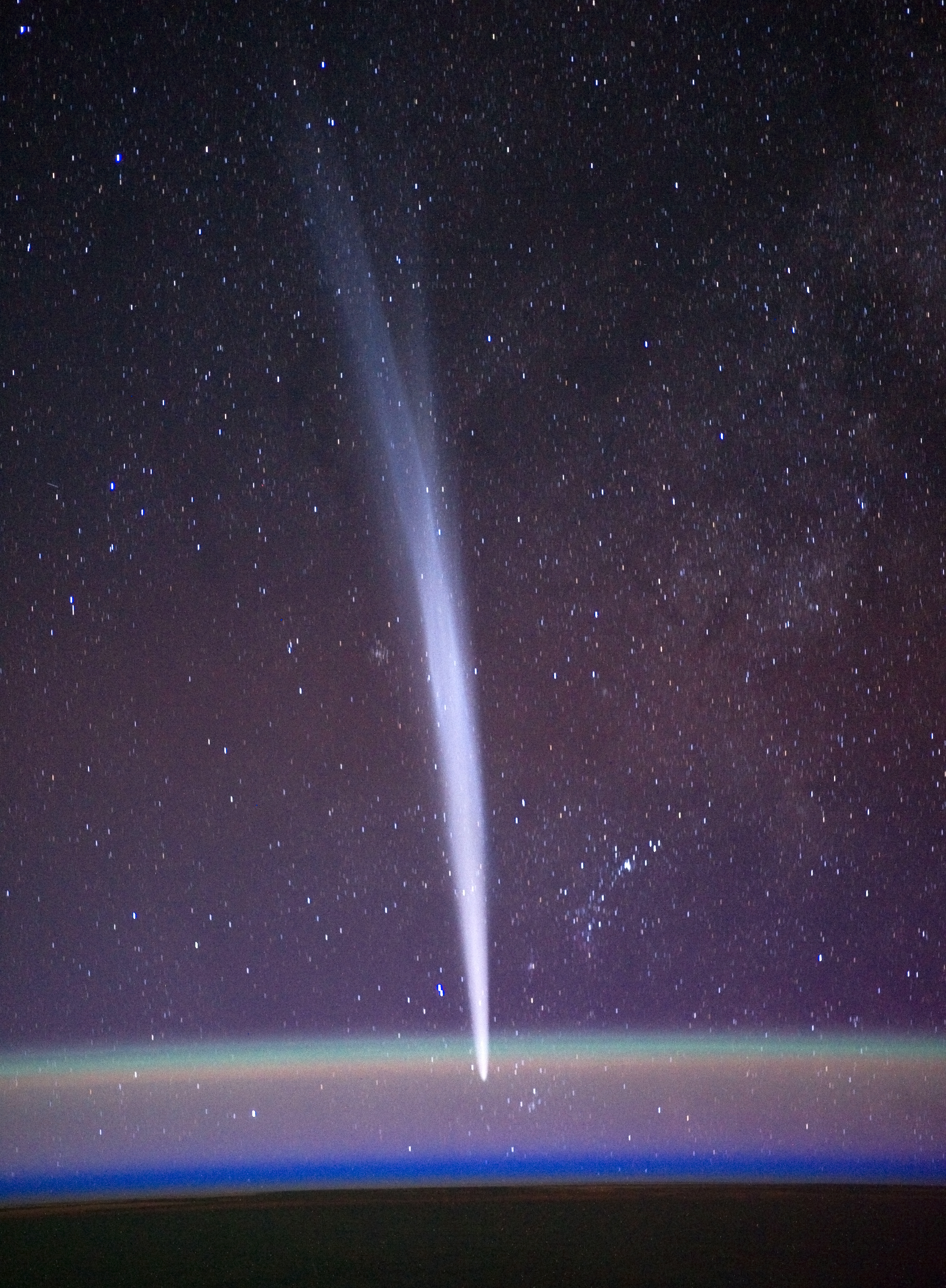 |
| Comet Lovejoy seen from orbit |
Comets are distinguished from asteroids
by the presence of an extended, gravitationally unbound atmosphere
surrounding their central nucleus. This atmosphere has parts termed the
coma (the central part immediately surrounding the nucleus) and the tail
(a typically linear section consisting of dust or gas blown out from
the coma by the Sun's light pressure or outstreaming solar wind plasma).
However, extinct comets that have passed close to the Sun many times have lost nearly all of their volatile ices and dust and may come to resemble small asteroids.
Asteroids are thought to have a different origin from comets, having
formed inside the orbit of Jupiter rather than in the outer Solar
System.
 |
| Comet 17P/Holmes and its blue ionized tail | | | | | | |
 |
| Comet C/2006 P1 (McNaught) taken from Victoria, Australia 2007 |


Comments