Do u know the Brightest star visible from Earth?
The Luminosity of a star in our galaxy is measured in Apparent Magnitude...
The apparent magnitude of a celestial object is a measure of its brightness as seen by an observer on Earth, adjusted to the value it would have in the absence of the atmosphere. The brighter an object appears, the lower the assigned value of its magnitude (inverse relation). In addition, the magnitude's scale is logarithmic, which means that a difference of one step corresponds to a change in brightness by a factor of about 2.5.
Generally the visible spectrum (vmag) is used as a basis for the apparent magnitude, but other regions of the spectrum, such as the near-infrared J-band, are also used. In the visible spectrum Sirius is the brightest star in the visible sky (excluding the Sun), whereas in the near-infrared J-band, Betelgeuse is the brightest. The apparent magnitude of stars is measured with an instrument called a bolometer.Given a visible luminosity (not total luminosity), one can calculate the apparent magnitude of a star from a given distance (ignoring extinction):
![m_{\rm star}=m_\odot-2.5\log_{10}\left[\frac{L_{\rm star}}{L_\odot}\left(\frac{d_\odot}{d_{\rm star}}\right)^2\right]](https://upload.wikimedia.org/math/8/7/7/8776cc1dfc800de3e6cc4a4a9318670e.png)
where
 is the apparent magnitude of the star (a pure number)
 is the apparent magnitude of the Sun (also a pure number)
 is the visible luminosity of the star
 is the solar visible luminosity
 is the distance to the star
 is the distance to the Sun
Or simplified, given  ,
,  :
:
, : , where is measured in .
1. Sirius
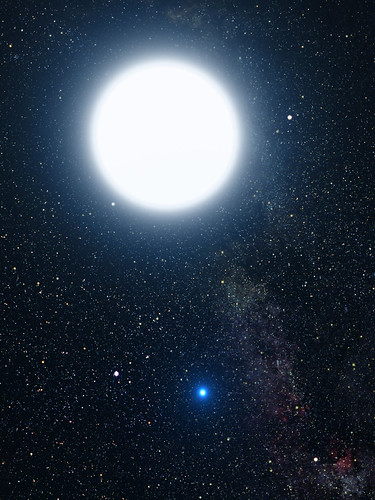
Sirius is the brightest star in the night sky. With a visual apparent magnitude of −1.46, it is almost twice as bright as Canopus, the next brightest star. What the naked eye perceives as a single star is actually a binary star system, consisting of a white main-sequence star of spectral type A1V, termed Sirius A, and a faint white dwarf companion of spectral type DA2, called Sirius B. The distance separating Sirius A from its companion varies between 8.2 and 31.5 AU. Sirius appears bright because of both its intrinsic luminosity and its proximity to Earth. At a distance of 2.6 parsecs, as determined by the Hipparcos astrometry satellite, the Sirius system is one of Earth’s near neighbors; for Northern-hemisphere observers between 30 degrees and 73 degrees of latitude (including almost all of Europe and North America), it is the closest star (after the Sun) that can be seen with the naked eye. Sirius is gradually moving closer to the Solar System, so it will slightly increase in brightness over the next 60,000 years. After that time its distance will begin to recede, but it will continue to be the brightest star in the Earth’s sky for the next 210,000 years.
2. Canopus

is the brightest star in the southern constellation of Carina, and the second brightest star in the night-time sky, after Sirius. Canopus’s visual magnitude is −0.72, and it has an absolute magnitude of −5.53. Canopus is a supergiant of spectral type F. Canopus is essentially white when seen with the naked eye. It is located in the far southern sky, at a declination of −52° 42′ (2000) and a right ascension of 06h24.0m.
In the southern hemisphere, Canopus and Sirius are both visible high in the sky simultaneously, and reach the meridian
just 21 minutes apart. It is a circumpolar star when seen from points that have latitude south of 37°18′ south;
F-type supergiants have been described as yellow-white or white. Canopus has a B-V color index of 0.16 where 0 is a blue-white, indicating it is essentially white, although has been described as
yellow-white. It has less yellow than Altair or Procyon.
It may be that some observers have perceived it as yellow-tinged owing to its being located low in the sky and hence subject to atmospheric effects.
Canopus is the most intrinsically bright star within approximately 700 light years, and it has been the brightest star in Earth’s sky during three different epochs over the past four million years. Other stars
appear brighter only during relatively temporary periods, during which they are passing our solar system at a much closer distance than Canopus.
About 90,000 years ago, Sirius moved close enough that it became brighter than Canopus, and that will remain the case for another 210,000 years. But in 480,000 years,
Canopus will once again be the brightest, and will remain so for a period of about 510,000 years.
Canopus is part of the Scorpius-Centaurus Association, a group of stars which share similar origin.
3.Regil Kenataurus
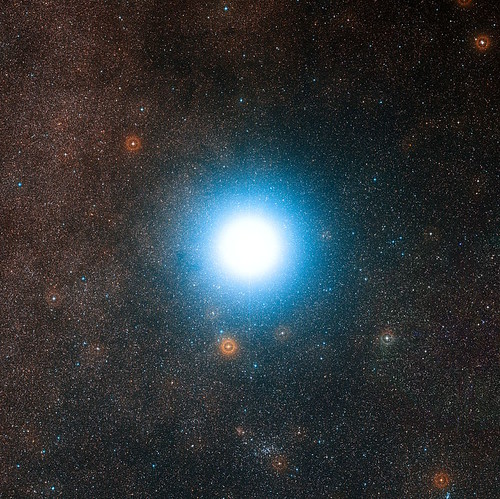
Rigel Kentaurus is the third-brightest star in the night sky. However, its brightness is due to the proximity of the system — commonly known as Alpha Centauri — which is the sun’s closest neighbor, about 4.3 light-years away from Earth. Rigel Kentaurus is part of a triple star system, and the naked-eye star itself is a double star.
Its two stars are dwarfs that spin around each other every 80 years at an average distance of 23 Earth-sun distances, or astronomical units. This puts the stars at about the same equivalent distance apart as the sun and Uranus in our own solar system, according to University of Illinois astronomer Jim Kaler.
By itself, Alpha Centauri A is the fourth brightest star in the sky; just a bit dimmer, by 0.02 of a magnitude, than Arcturus. It is a yellow star of the same type (G2) as the sun, and it is about 25 percent larger. Alpha Centauri B is an orange K2-type star, slightly smaller than the sun. Proxima Centauri is a red dwarf about seven times smaller than the sun, or one-and-a-half times bigger than Jupiter.
In 2012, astronomers discovered an Earth-size planet orbiting Alpha Centauri B, which is the smaller of the two dwarfs in Rigel Kentaurus. The planet, however, is far too close to its star to support life as we know it.
By itself, Alpha Centauri A is the fourth brightest star in the sky; just a bit dimmer, by 0.02 of a magnitude, than Arcturus. It is a yellow star of the same type (G2) as the sun, and it is about 25 percent larger. Alpha Centauri B is an orange K2-type star, slightly smaller than the sun. Proxima Centauri is a red dwarf about seven times smaller than the sun, or one-and-a-half times bigger than Jupiter.
In 2012, astronomers discovered an Earth-size planet orbiting Alpha Centauri B, which is the smaller of the two dwarfs in Rigel Kentaurus. The planet, however, is far too close to its star to support life as we know it.
4.Arcturus
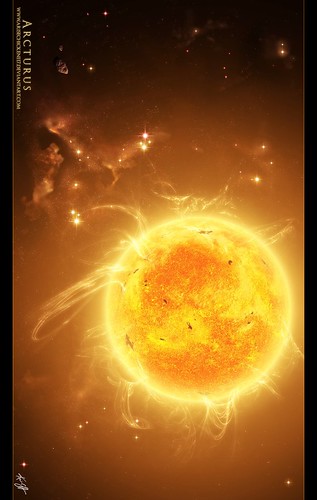
Arcturus, a red giant, looks orange to the eye. It is the brightest star on the northern half of Earth’s sky dome. Arcturus is especially noteworthy for its large proper motion, or sideways motion across our sky. Only Alpha Centauri – our sun’s nearest neighbor among the stars – has a higher proper motion among the first-magnitude, or bright, stars in the stellar neighborhood.
Arcturus is a type K1.5 IIIpe orange giant star, with an absolute magnitude of −0.30. It has likely exhausted its hydrogen from the core and is currently in its active hydrogen shell burning phase. It will continue to expand before entering horizontal branch stage of its life cycle.
Arcturus is thought to be an old star. It appears to be moving with a group of at least 52 other such stars, known as the Arcturus stream. Arcturus is likely to be considerably older than our sun. When the sun evolves to become a red giant, the sun might be a star much like Arcturus is now.
The closest approach of Arcturus will happen in about 4,000 years, when the star will be a few hundredths of a light-year closer to Earth than it is today.
The red giant Arcturus is roughly 25 times the diameter of our sun. It is not the largest of the red giant. Because of its larger size, in visible light Arcturus radiates more than 100 times the light of our sun. If you consider infrared and other forms of radiant energy, Arcturus is about 200 times more powerful than the sun. Its mass is hard to exactly determine, but may be slightly greater than that of our sun (1.1-0.4+0.6 solar mass).
Arcturus is thought to be an old star. It appears to be moving with a group of at least 52 other such stars, known as the Arcturus stream. Arcturus is likely to be considerably older than our sun. When the sun evolves to become a red giant, the sun might be a star much like Arcturus is now.
The closest approach of Arcturus will happen in about 4,000 years, when the star will be a few hundredths of a light-year closer to Earth than it is today.
The red giant Arcturus is roughly 25 times the diameter of our sun. It is not the largest of the red giant. Because of its larger size, in visible light Arcturus radiates more than 100 times the light of our sun. If you consider infrared and other forms of radiant energy, Arcturus is about 200 times more powerful than the sun. Its mass is hard to exactly determine, but may be slightly greater than that of our sun (1.1-0.4+0.6 solar mass).
5. Vega
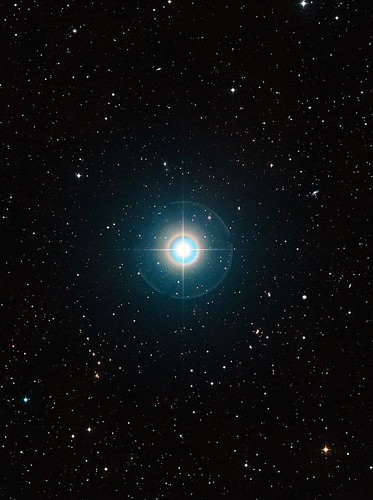
Vega is the brightest star in the constellation Lyra the Harp. That’s why it’s often called the Harp Star. Observers in the Northern Hemisphere can see the star Vega come into view in the northeast in mid-evening in May. Look for this star in the very early evening in June – high overhead on autumn evenings – in the northwestern quadrant of the sky on December evenings.
Vega is easily recognizable for its brilliance and blue-white color. You can also easily pick out its constellation Lyra, which is small and compact, and consists primarily of Vega and four fainter stars in the form of a parallelogram.
The little constellation Lyra has some interesting features. Near Vega is Epsilon Lyrae, the famed “double-double” star. Between the Gamma and Beta stars is the famous Ring Nebula, visible in small telescopes.
Vega is one of three stars in an asterism – or noticeable star pattern – called the Summer Triangle to the early evening sky. The other two stars in the Triangle are Deneb and Altair. You can see the Summer Triangle in the evening beginning around June, through the end of each year.
The little constellation Lyra has some interesting features. Near Vega is Epsilon Lyrae, the famed “double-double” star. Between the Gamma and Beta stars is the famous Ring Nebula, visible in small telescopes.
Vega is one of three stars in an asterism – or noticeable star pattern – called the Summer Triangle to the early evening sky. The other two stars in the Triangle are Deneb and Altair. You can see the Summer Triangle in the evening beginning around June, through the end of each year.
Vega is the 5th brightest star visible from Earth, and the 3rd brightest easily visible from mid-northern latitudes, after Sirius and Arcturus. At about 25 light-years in distance, it is the 6th closest of all the bright stars, or 5th if you exclude Alpha Centauri, which is not easily visible from most of the Northern Hemisphere.
Vega’s distinctly blue color indicates a surface temperature of nearly 17,000 degrees F, making it about 7,000 degrees hotter than our sun. Roughly 2.5 times the diameter of the sun, and just less than that in mass, Vega’s internal pressures and temperatures are far greater than our sun, making it burn its fuel faster. This causes Vega to produce 35-40 times the energy of the sun, which in turn shortens its lifetime. At about 500 million years, Vega is already middle-aged. Currently it is only about a tenth the age of our sun, and will run out of fuel in another half-billion years.


Comments